Naperville, IL
Concrete & Heavy Debris Dumpster Rental in Naperville
Broken concrete, brick, block, dirt, and clay from Naperville driveways, patios, and pool removals hauled in dedicated heavy-debris boxes sized for road weight limits, not the biggest box on the lot. Flat-rate pricing, same-day delivery when you call before noon.
- Same dayDelivery available
- Flat rateQuoted up front
- Since 2012Locally owned
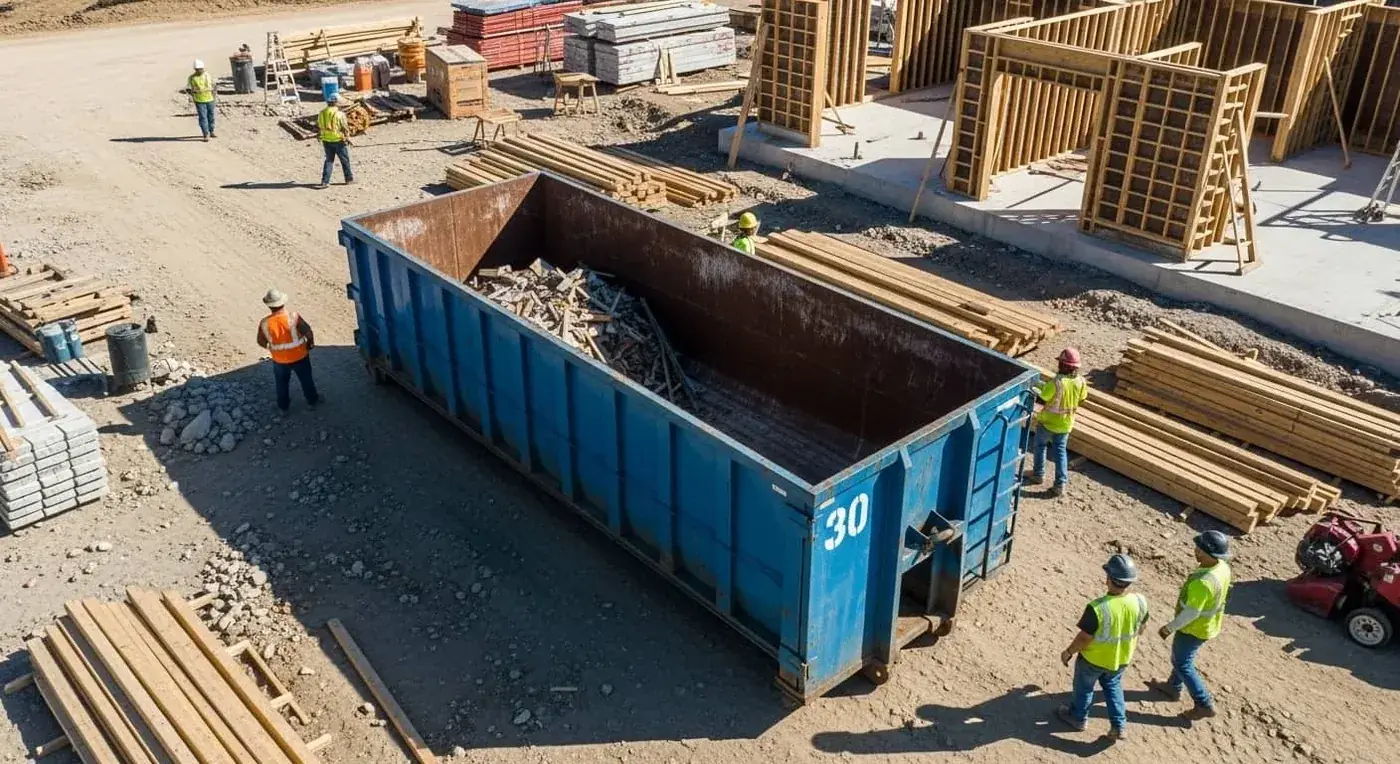
Every week we get the same call: a homeowner off Aurora Avenue or a contractor working the Route 59 corridor wants a 30 yard dumpster for a driveway tear-out, and we talk them down to a 10. That's not upselling in reverse - it's because concrete, brick, and dirt are dense enough that a 10 yard box hits its legal road weight before it's anywhere near full. We've been running heavy debris out of Naperville since 2012, and the sizing math for a broken patio or a pool removal is nothing like the math for a basement cleanout.
This page covers what a cubic yard of concrete, brick, and DuPage clay actually weighs, why we load heavy debris in dedicated clean boxes instead of mixing it with a general demo load, and how Illinois' CCDD rules separate ordinary broken concrete and uncontaminated soil from material that has to go to a regulated landfill. Call (331) 244-7243 before you start breaking up concrete - we'll tell you the right box before you're stuck with a driveway's worth of rubble and no place to put it.
What we handle on concrete & heavy debris jobs
- Materials accepted: concrete, asphalt, brick, block, stone, tile, dirt, clay, sand, and gravel
- Dedicated clean-load heavy-debris boxes - no drywall, trash, or treated wood mixed in with concrete or dirt
- 10 yard boxes filled to a marked line, not the top, to stay within legal road weight limits
- Flat-rate pricing includes delivery, pickup, and disposal up to the quoted tonnage
- Same-day delivery across Naperville, DuPage County, and Will County when you call before noon
- Guidance on Illinois CCDD rules for uncontaminated concrete, brick, rock, and soil
- Driveway and yard protection set up before a loaded heavy box goes down
- Licensed and insured, operating in the Naperville area since 2012
Why a 10 Yard Box Beats a 30 for Concrete and Dirt
Roll-off trucks and the roads they drive on have legal axle weight limits, and Illinois enforces them. A 30 or 40 yard dumpster is built to carry volume - old carpet, furniture, cabinets, drywall - material that's bulky but light. Fill that same box with broken concrete or wet clay and you'll blow past the truck's safe hauling weight while the box still looks half empty. Our drivers have had to leave loaded heavy boxes sitting at the curb because someone filled a 20 yard container to the top with concrete rubble - that's a wasted trip and a delayed project.
The rule we give every customer is simple: fill it to the line, not to the top. Every heavy-debris box we drop gets a fill line marked at roughly two-thirds height for concrete, brick, and dirt. Stop there and you're at or near the weight limit even though there's visible space left. For most Naperville driveway, patio, and small foundation jobs, a 10 yard container filled to the line hauls more usable material - and costs less - than a 20 or 30 that never gets close to full before it maxes out on weight. Not sure how a heavy job compares to a general one? Our dumpster size guide breaks down every option side by side.
What a Cubic Yard of Concrete, Brick, and Dirt Actually Weighs
These are approximate ranges - actual weight depends on how broken up the material is, how much rebar or wire mesh is mixed in, and how wet the dirt or clay is when it's loaded. Wet DuPage clay in particular can run noticeably heavier than the dry-weight numbers most online calculators quote.
| Material | Approx. weight per cubic yard | How much fits in a 10 yard box |
|---|---|---|
| Broken concrete | 2,000-2,400 lb | 4-5 cubic yards (fill line, not full) |
| Asphalt millings/chunks | 2,000-2,700 lb | 4-5 cubic yards |
| Brick and block | 2,700-3,200 lb | 3-4 cubic yards |
| Stone, gravel, sand | 2,400-3,000 lb | 3-4 cubic yards |
| Dry topsoil/dirt | 2,000-2,400 lb | 4-5 cubic yards |
| Wet clay (typical DuPage subgrade) | 2,700-3,400 lb | 3-4 cubic yards |
Run those numbers and a 10 yard box loaded to the line lands somewhere around 4-5 tons for most concrete and dirt jobs - which is exactly the weight window our heavy-debris pricing is built around. Ask us for the included tonnage on your quote before delivery so there's no guessing at pickup - our dumpster rental cost guide walks through how weight factors into flat-rate pricing.
Clean Loads Only: Why We Run Dedicated Heavy-Debris Boxes
We don't let concrete and dirt jobs share a box with general demo debris, and it's not just about weight. Concrete, brick, and clean soil can be routed to a clean-fill or crushing operation instead of a landfill, which is cheaper to process and better for everyone's bottom line - including what we're able to charge you. The moment that load has drywall, shingles, paint cans, treated wood, or a few contractor bags of trash mixed in, it stops qualifying as clean material and has to be handled - and disposed of - like ordinary construction debris. That reclassification is the single biggest reason a "simple" concrete job ends up costing more than quoted.
So a heavy-debris box from us comes with one rule: concrete, asphalt, brick, block, stone, tile, dirt, clay, sand, and gravel only. No rebar sticking a foot out of a slab chunk, no fence posts still set in concrete footings, no root balls buried in the spoil pile. Break it down, knock the dirt off, and pull the metal before it goes in the box. If your project genuinely has both heavy material and general demo debris - a garage tear-down with a concrete slab, say - we'll set you up with two boxes rather than one contaminated load; see our demolition debris page for how we handle mixed teardown jobs, or our residential and commercial dumpster rental pages if concrete is only part of a bigger project.
Illinois CCDD Rules: Clean Fill vs. Regulated Soil
Illinois regulates what can be used as clean fill under the Clean Construction or Demolition Debris (CCDD) program, administered by the Illinois EPA under 35 Ill. Adm. Code 1100. Uncontaminated broken concrete (without protruding rebar), brick, rock, stone, and reclaimed asphalt pavement generally qualify as CCDD. Soil is treated differently: it only qualifies as clean fill when it meets IEPA's chemical concentration and pH standards, and soil from a site with a history of industrial use, an old underground storage tank, or a former gas station or dry cleaner can require testing and certification by a licensed professional engineer or geologist before it's accepted anywhere.
What this means for a Naperville homeowner or contractor: ordinary broken driveway concrete or a clean backyard excavation for a patio footing is routine and moves through the system without much friction. Soil pulled from a site with any contamination history is a different, regulated problem that needs its own paper trail and can't just go in a standard heavy-debris box. If you're not sure which category your dirt falls into, tell us the site history when you book and we'll flag it before delivery rather than after a load gets rejected at the facility. General questions about what's allowed in any box are covered on our FAQ page and in our Naperville recycling and disposal guide.
Naperville and DuPage Job Sites We Load Every Week
A large share of our concrete calls come from the ring of subdivisions built through the 1970s and 80s - Naperville neighborhoods where the original driveways and patios are past their service life and homeowners are replacing broken, heaving concrete slabs. Pool removals are close behind: a lot of the in-ground pools installed in that same building boom are now getting decommissioned, and a standard pool shell breakout generates several tons of concrete and rebar that needs a dedicated heavy box, not a general dumpster.
We also see steady work from retaining wall rebuilds on sloped lots near the West Branch DuPage River corridor, and from commercial flatwork along the Route 59 corridor - parking lot sections, curb and gutter replacement, loading dock aprons. One thing that catches people off guard on both residential and commercial jobs near the river corridor: DuPage County sits on heavy glacial till, and clay subgrade near the floodplain holds water. Spoil dug in spring or after rain routinely weighs more than the same dirt would dry, which is exactly why we quote heavy-debris jobs by the box and the fill line, not by a flat volume estimate. We run the same heavy-debris boxes out to Aurora, Plainfield, and Bolingbrook job sites, so the sizing rules below apply the same way whether the slab is in Naperville proper or out along the Will County line.
Booking a Heavy-Debris Box in Naperville
Flat-rate pricing on a heavy-debris box includes delivery, pickup, and disposal up to the tonnage we quote for that size - no separate weight-overage surprise if you fill to the line like we ask. Call before noon and we can usually get a box on-site the same day, which matters when a concrete contractor's crew is standing around waiting on a place to put the slab they just broke up. We'll also talk through driveway protection before drop-off, since a loaded heavy box is considerably heavier on your asphalt or pavers than a typical construction dumpster.
Not sure whether your job is a heavy-debris box or a standard construction container? Check our sizing guide or just call (331) 244-7243 and describe the job - square footage of slab, whether there's a pool shell involved, how much dirt is coming out of the ground - and we'll size it correctly the first time. See our same-day dumpster rental page for how the noon cutoff works, and our construction debris disposal guide for how heavy boxes fit into a larger job.
Right-sized
Which dumpster for concrete & heavy debris in Naperville?
We would rather talk you down a size than sell you air. These are the boxes that suit this work.
10 Yard Dumpster Dumpster
The default for concrete, brick, and dirt. Filled to the line, it carries roughly 4-5 tons of heavy material without exceeding road weight limits - the right call for a driveway, patio, or small footing tear-out.
Size details 15Cubic yards15 Yard Dumpster Dumpster
Useful when a job mixes moderate concrete or brick with some lighter demo debris, such as a patio replacement that also includes an old wood deck or fence removal.
Size details 20Cubic yards20 Yard Dumpster Dumpster
For larger footprints - full driveway replacements or a pool shell breakout - split across a heavier fill line so the box still hauls legally even though it looks less than full.
Size detailsLocal knowledge
Concrete & Heavy Debris across Naperville and DuPage County
Illinois regulates clean fill through the Illinois EPA's Clean Construction or Demolition Debris program under 35 Ill. Adm. Code 1100 - the rules that determine whether broken concrete, brick, and soil can go to a clean-fill site or need to be handled as regulated waste. You can read the program overview on the Illinois EPA CCDD page and the full administrative rule text through the Illinois General Assembly's JCAR administrative code.
Naperville sits along the West Branch DuPage River, and the clay-heavy subgrade through that corridor is well documented by DuPage County's own stormwater program - see the West Branch DuPage River watershed page for the drainage area our crews work around on retaining wall and excavation jobs near the river corridor. Between the CCDD paperwork and the clay subgrade, heavy-debris jobs in this area need more planning than a typical cleanout, and we've been sizing and routing these loads out of Naperville since 2012. If you're weighing a full teardown against a concrete-only job, our construction dumpster rental and demolition debris pages cover the broader project options.
Towns we cover
We run concrete & heavy debris out of our High Grove Lane yard across Naperville and the surrounding suburbs.
FAQs
Concrete & Heavy Debris questions, answered
Why can't I just get a 30 yard dumpster and fill it with concrete?
You can order one, but you'll almost never fill it. Road weight limits mean a 30 yard box loaded with concrete or dirt hits its legal hauling weight long before it's full - our drivers will ask you to stop loading well short of the top. A 10 yard box, filled correctly, usually handles the same tonnage for less money.
How much does a cubic yard of concrete or dirt actually weigh?
Broken concrete runs roughly 2,000-2,400 lb per cubic yard. Dirt is similar when dry but climbs to 2,700-3,400 lb per cubic yard when it's wet clay, which is common in DuPage County subgrade. Brick and block run heavier still, around 2,700-3,200 lb per cubic yard.
Can I mix concrete with regular construction trash in the same box?
Not in a heavy-debris box. Mixing drywall, shingles, trash bags, or treated wood into a concrete or dirt load reclassifies the whole load away from clean fill and typically raises the disposal cost. If your job has both, we'll set you up with two containers - a heavy box for the concrete and a standard box for everything else.
What is CCDD and does my project need to worry about it?
CCDD (Clean Construction or Demolition Debris) is the Illinois EPA program covering uncontaminated broken concrete, brick, rock, stone, and asphalt pavement, plus soil that meets specific chemical standards. Most residential driveway, patio, and pool-removal jobs are routine. Soil from a property with an industrial or fuel-tank history is treated as a separate, regulated issue that needs testing before disposal.
Do you take dirt and clay from excavation, or just concrete and brick?
Both. Our heavy-debris boxes take concrete, asphalt, brick, block, stone, tile, dirt, clay, sand, and gravel. What we ask you to keep out is metal-heavy rebar chunks, tree stumps and root balls, and anything wet enough to be closer to mud than soil - call us if you're not sure.
How fast can you get a heavy-debris dumpster to my Naperville address?
Call before noon at (331) 244-7243 and we can typically deliver the same day, anywhere in Naperville, DuPage County, Will County, or Chicago's western suburbs. We'll also confirm the right size and set up driveway protection before the box goes down.
Ready when you are
Book concrete & heavy debris in Naperville
Call and you will speak to someone local who knows the streets, the permit rules and which box actually fits your driveway. Flat rate quoted up front.
Keep going
Related services
Residential Dumpster Rental
Driveway-friendly roll-offs for cleanouts, remodels and moves.
View serviceEstate Cleanout Dumpsters
Discreet, patient service for probate and downsizing deadlines.
View serviceCommercial Dumpster Rental
Scheduled and on-call containers for offices, retail and property managers.
View service