We get this question on nearly every phone call, and it's a fair one: you're about to let a steel container that weighs 5,000-8,000 pounds empty sit on a driveway you paid good money to pour or repave. The honest answer is that a dumpster can damage a driveway, but rarely the way people picture it. Nobody's slab cracks because a pile of drywall and shingles is heavy. It cracks — or more often just scuffs and dents — because of where the load concentrates and what the pavement underneath is doing that particular day.
After placing thousands of boxes on driveways from the Historic District out to Naperville's west-side subdivisions, we've learned exactly where things go wrong and how to prevent it. This is the same protocol our drivers run on every residential dumpster rental delivery, not a marketing promise.
The load isn't spread out — it's concentrated at a few points
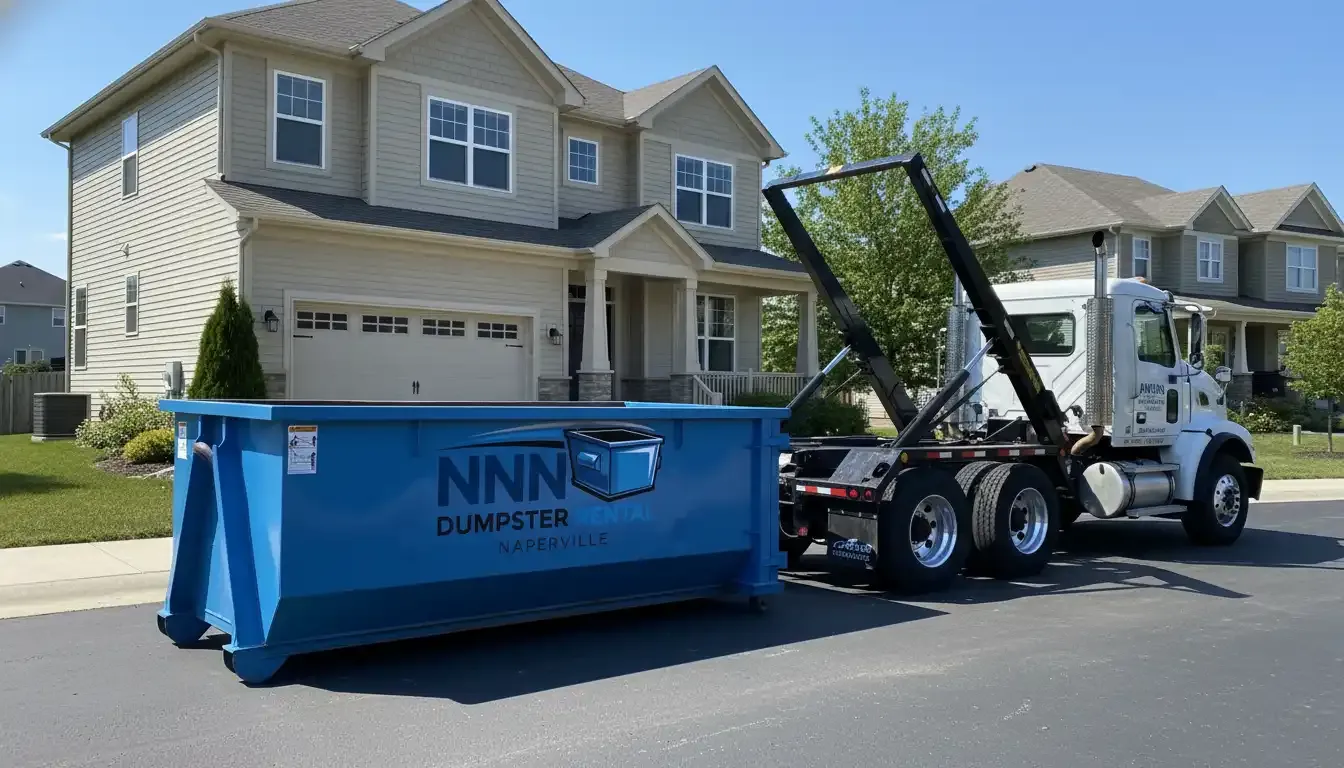
A roll-off box doesn't sit flat on your driveway the way a parked car does. It rests on two steel rails running its length, and those rails ride on a set of rollers at the rear. When the truck's hydraulic hoist tips the box off and pulls out from underneath, the entire weight settles onto a narrow footprint of rail and roller contact — a concentrated point load, not a distributed one. That's why a dumpster can dent pavement that would easily support a pickup truck spread across four tires.
The second load event, and the one that catches homeowners off guard, is the delivery truck itself. An empty roll-off truck can weigh 25,000-30,000 pounds, and its axle weight rolls over your driveway apron even if the box never touches that section. We often see more stress on an aging apron from the tandem axles backing in than from the container itself.
Asphalt vs. concrete: not a close contest, especially in July
Concrete driveways handle roll-off placement well in almost any weather. Properly poured concrete over a compacted base shrugs off point loads from rails and rollers with little more than the risk of a surface scuff. Asphalt is a different story, and it's weather-dependent in a way concrete isn't.
Asphalt is a petroleum-based binder holding aggregate together, and it softens with heat. On a 90-degree, humid DuPage County afternoon — common from June through August — surface temperatures climb well past the air temperature, and asphalt under a concentrated roller load can indent or rut. We've pulled off boxes in August and found roller impressions that a February delivery on the same driveway never would have caused. If your timeline has any flexibility during a heat wave, morning delivery and pickup meaningfully cuts the risk.
Winter and early spring bring the opposite problem. DuPage County's clay-heavy subgrade holds water, and during freeze-thaw cycles the ground under your driveway expands and contracts. In the thaw window — typically March into early April here — the sub-base can be saturated and soft even though the surface looks solid. Asphalt over a soft, saturated base has almost nothing to distribute the load into, and that's when we see the most cracking risk all year, worse in some ways than peak summer heat.
Plywood under the rails: why 3/4-inch beats 1/2-inch
Our standard protocol on any asphalt driveway, and on most concrete driveways more than a few years old, is to lay plywood under the path of the rails and directly under the rear rollers before the box comes off the truck. This isn't optional padding — it's the single biggest variable in whether your driveway comes through clean.
We use 3/4-inch plywood, not 1/2-inch, and the difference matters more than it sounds like it should. Half-inch plywood flexes under a concentrated roller load and can bottom out, transmitting nearly the full point load straight through to the asphalt anyway — protected against scraping, not against indentation. Three-quarter-inch plywood is stiff enough to actually spread that load across a wider footprint before it reaches the surface. On steep or heavily crowned driveways, common on older streets near the Riverwalk, we'll double up boards under the roller zone.
Pavers and stamped concrete need a different approach entirely
Interlocking paver driveways and stamped decorative concrete are a category of their own. Pavers aren't a monolithic surface — they're individual units set in a sand bedding layer, and a rail dragging even slightly can shift or chip pavers, especially at the joints. Stamped concrete has a decorative texture that's more prone to cosmetic scuffing than plain broom-finished concrete, even though the structural slab underneath is just as strong.
For both, we extend plywood coverage further than usual and stage the placement angle so the box goes down in one motion rather than getting dragged and repositioned. Mention it when you book — it changes how we stage the truck before your roll-off dumpster ever comes off the hoist.
The apron and curb cut take more abuse than people expect
The transition zone where your driveway meets the street — the apron — absorbs the truck's axle weight at its steepest approach angle, plus the friction of straightening out while backing in. Older curb cuts throughout Naperville, particularly in neighborhoods built before current paving standards, sometimes have a thinner concrete section here than the driveway itself. We watch this zone closely and adjust the truck's angle to avoid dragging the rear tires over a cracked or settled apron.
Clearance the driver actually needs
Every driveway problem above gets worse if the truck has to maneuver or re-angle multiple times to line up — extra passes mean extra load cycles on the same stressed pavement. Give the driver a clean shot and risk drops automatically. As a rule of thumb, our drivers need:
- Roughly 60 feet of straight, unobstructed approach to back in without a multi-point turn
- 10-12 feet of clear width along the driveway and placement zone
- 22-25 feet of vertical clearance if the box needs to come off in a raised position, which is standard hoist geometry on most roll-off trucks
That vertical clearance number is the one people forget. Mature tree canopy is one of the best things about older Naperville neighborhoods, but low branches near the Riverwalk and Historic District can be a real problem for a hoist truck. We'll ask about overhead branches and utility drop lines when you book, and if there's any question we'll ask for a quick photo before delivery day.
Sprinkler heads, gates, and HOA landscaping
Irrigation lines and sprinkler heads sit just a few inches under the surface near driveway and lawn borders, and they don't survive a roller passing over them. Flag any sprinkler heads near the placement zone before we arrive. The same goes for gates and HOA-installed landscaping — if you're in a community like Ashbury, White Eagle, or Tall Grass with defined landscape borders or shared driveway aprons, tell us about placement restrictions when you book. Many HOAs also have their own visibility or duration rules separate from city permitting, worth a quick check alongside our Naperville permit guide.
When the street is genuinely the better call
Sometimes the right answer isn't extra plywood — it's not putting the box on the driveway at all. If you have a paver drive you don't want to risk, a driveway with visible cracking, a steep grade, or not enough clean approach room, placing the container at the curb with a City of Naperville right-of-way permit is often the smarter move. It's a straightforward process — we handle the permit application for you on most jobs. Street placement carries its own rules around reflective markers, duration limits, and keeping the container clear during snow season, but for a driveway you want protected at all costs, it's worth the extra paperwork.
What this means for your project
Whether you're clearing out a house for an estate cleanout, tearing off a roof, or running a full remodel, the driveway conversation should happen before the truck leaves our yard, not after. Tell us your surface type, any overhead branches, and where your sprinkler heads sit, and we'll build the placement plan around it. For heavier loads like a concrete or heavy debris haul, or a construction dumpster rental with heavy foot traffic near the box, we'll often use the widest plywood footprint we offer, since the container gets loaded and reloaded more over the rental period.
Picking the right container size also reduces driveway risk indirectly — an oversized box sits there longer and gets loaded more than necessary. Our dumpster size guide walks through choosing between a 20-yard and a 30-yard unit for typical Naperville renovation and cleanout projects.
If you're not sure which category your driveway falls into, call us at (331) 244-7243 and describe it — surface, age, any cracking you've noticed, and roughly how the approach looks from the street. We'll tell you straight whether standard protection is enough or whether curb placement makes more sense for your situation. You can also see all our container options on the services page or reach out through our contact page to schedule.
None of this is complicated once someone walks you through it. A dumpster delivered with the right prep work, on the right surface, in the right conditions, leaves your driveway exactly how it found it. We'd rather spend five extra minutes with plywood and a conversation about your landscaping than have you calling back about a scuff mark. Ready to get a container scheduled? Call (331) 244-7243 and we'll walk through your driveway details before we ever load the truck.