
Naperville, IL
Roofing Dumpster Rental in Naperville, IL
Sized by roofing squares and layer count, not guesswork — because a tear-off hits its weight limit long before the box looks full. Flat-rate pricing, placement tight to the eave, and same-day delivery when you call before noon.
- Same dayDelivery available
- Flat rateQuoted up front
- Since 2012Locally owned
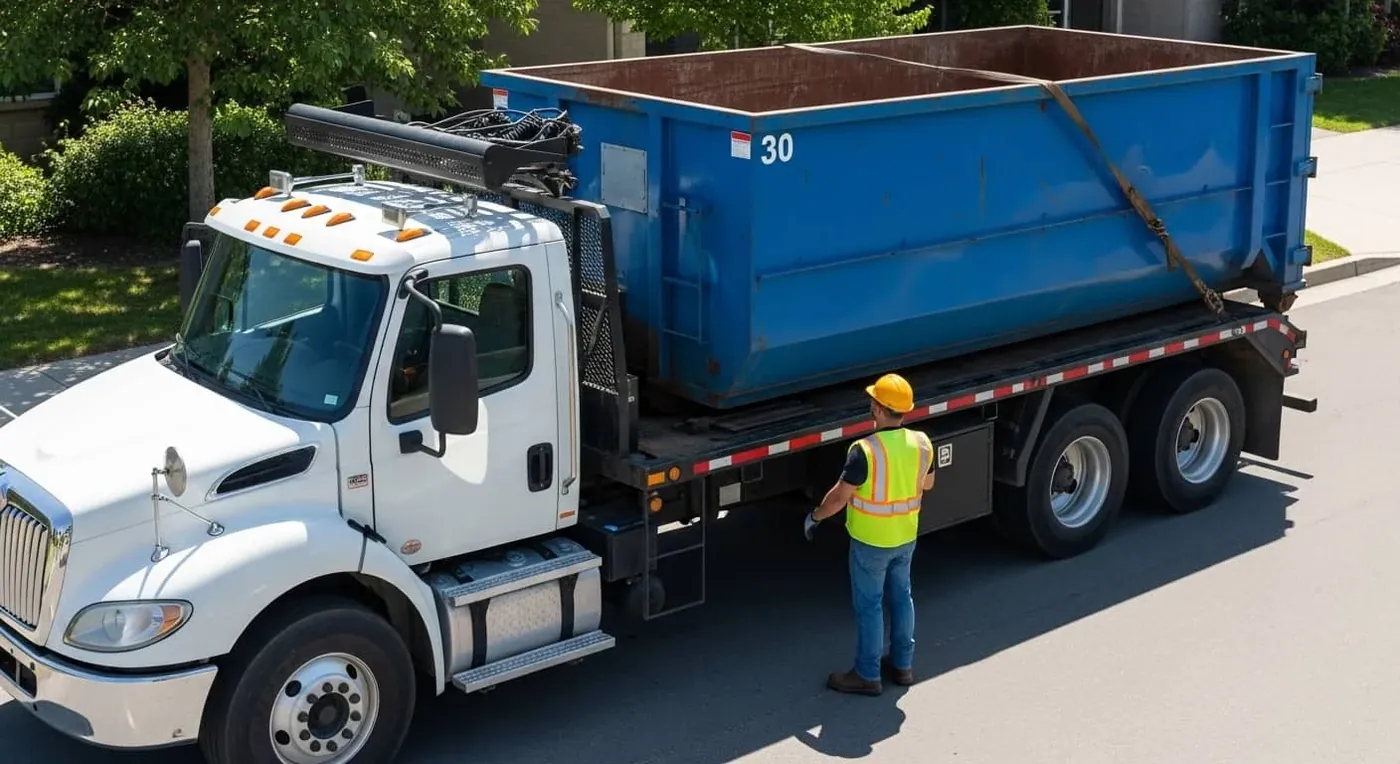
Roofing is the one dumpster rental job that breaks people's assumptions about size. A homeowner tearing off a 2,200 square-foot roof looks at a 20-yard container and figures it'll take a fraction of it. Then the crew starts throwing bundles off the eave and by mid-afternoon the driver is calling to say the box is at its weight limit with three feet of visible space still left inside. That's normal — shingles are dense, and every roofing dumpster we deliver in Naperville is priced and picked based on how much the load will weigh, not how much room it'll take up.
We've been running this route since 2012, through subdivisions built in the 1990s and early 2000s that are now hitting the back end of their shingle life, through the 2021 tornado's insurance reroofs, and through every spring hail season DuPage County throws at us. This page covers how we size a roofing dumpster by squares and layers, what changes the math, and how we protect your driveway and yard while the tear-off happens.
What we handle on roofing dumpster rental jobs
- Sized by roofing squares and layer count so you're not overpaying for volume you don't need or underpaying into an overweight surcharge
- Flat-rate pricing that includes delivery, pickup, and a set weight allowance — no surprise per-ton fees on a straightforward tear-off
- Delivery placed tight to the eave the crew is working first, so bundles go straight down instead of across the yard
- Plywood or blocking under every driveway drop, which matters more on roofing jobs given how fast the load weight climbs
- Same-day delivery when you call before noon — built for insurance reroofs and roofers who don't want a delayed start
- Straight guidance on when 3-tab, architectural, cedar shake, or tile changes your size and weight math
- Container held on-site through the final magnetic nail sweep instead of pulled the minute the last bundle lands
- Licensed and insured, run by Ryan Kowalski out of Naperville since 2012 — we know these subdivisions' roof ages firsthand
Why Roofing Hits the Weight Limit Before the Box Fills Up
Every roll-off has two limits: how much volume it holds and how much weight it's rated to carry on the truck and axles. For almost every other job — furniture, drywall, cardboard, general household junk — you run out of room before you run out of allowed weight. Roofing debris flips that. Shingles are compact and dense, so a tear-off dumpster reaches its weight allowance while it still looks half-empty from the street.
The rough industry figures we size against: standard 3-tab shingles run approximately 230-250 pounds per roofing square (a square being a 10x10 foot, 100 square foot section of roof), and architectural or dimensional shingles run approximately 400-430 pounds per square. Those are approximate ranges — actual weight varies by manufacturer, shingle thickness, and how much moisture the shingles picked up sitting on the roof — but they're close enough to plan a container size around. A 2,000 square foot ranch roof with architectural shingles, single layer, is roughly 20 squares, which puts the tear-off debris alone in the 4-4.5 ton range before you've added decking or underlayment.
Sizing by Roofing Squares, Not Guesswork
We ask three questions before quoting a roofing job: how many squares, how many layers of shingles coming off, and whether you're also tearing off decking. That's enough to land on the right box on the first try, which matters because a swap-out mid-job costs you a half-day of standing around waiting on a truck. Here's how we typically size it:
| Roofing Squares | Layers | Typical Dumpster |
|---|---|---|
| Up to 15 squares | 1 layer, architectural | 10-yard |
| 15-25 squares | 1 layer, architectural | 15-yard |
| 20-30 squares | 1 layer, or up to 20 squares with 2 layers | 20-yard |
| 30+ squares or 2-layer tear-off on a large home | 2 layers | Two runs of a 15-yard or a 20-yard swapped mid-job |
That last row is the honest answer for a lot of the two-story homes we see in Woodridge and Darien with a second layer coming off — the volume and weight both climb fast enough that one box either overflows or maxes out on weight before the crew is done. We'd rather tell you that upfront than have the driver refuse an overloaded container on pickup day. Call (331) 244-7243 and give us the square count off your last roofing invoice or measurement and we'll size it in a couple minutes.
Layers, Decking, Underlayment, and the Exceptions
The square-and-layer math above covers a standard asphalt shingle tear-off. A few things push the weight estimate up, and one changes it entirely:
- Second layer of shingles: add the full per-square weight again — a two-layer tear-off roughly doubles shingle weight alone, which is why we push those jobs to a bigger box or a second pull.
- Decking replacement: if the roofer is also pulling bad plywood or OSB decking, figure roughly 2-3 pounds per square foot of sheathing on top of the shingle estimate.
- Underlayment and ice-and-water shield: not heavy on its own, but on Naperville roofs it's usually installed along every eave and valley per Illinois building practice for ice dam protection, so it adds up on a full tear-off.
- Cedar shake: runs lighter per square than architectural shingles but bulkier, so shake tear-offs are usually a volume problem, not a weight problem — we size those closer to the container's fill line rather than its tonnage.
- Tile or slate: a different animal entirely. Concrete or clay tile can run 900 pounds or more per square, well outside standard shingle math, and it's rare enough in this market that we quote it as its own job — usually a smaller container carrying more weight, similar to how we handle a concrete or heavy debris load.
Placement, Driveway Protection, and Nail Cleanup
Where the dumpster sits matters as much as its size. We place roofing containers tight to the driveway edge nearest the eave the crew is tearing off first, so the guys on the roof are throwing bundles almost straight down instead of carrying them across the yard. On a two-story tear-off that placement decision alone saves the crew real time and keeps debris from scattering into landscaping beds.
We run plywood or wood blocking under the delivery wheels on every driveway drop, which matters more on roofing jobs than most because the loaded weight climbs fast and sits in one spot for the length of the job. August asphalt driveways in particular soften enough in Naperville's heat that unprotected roll-off wheels can leave permanent tracking if we don't lay boards down first — see our full driveway protection guide for how that works on every delivery, not just roofing.
Nails are the other half of the cleanup that homeowners don't always plan for. A responsible roofer runs a magnetic sweep of the driveway, walkway, and grass line around the dumpster once tear-off is done and again after the last bundle goes in — loose roofing nails in a driveway or garage floor cause flat tires for months if they're missed. We'll hold the dumpster on-site through that final sweep rather than pulling it the minute the last bundle lands.
Naperville's Roofs Are Aging Out Together
A lot of what drives our roofing calls isn't random — it's demographic. Subdivisions like Ashbury, White Eagle, Tall Grass, Cress Creek, and Saybrook were built out through the 1990s and early 2000s, and standard architectural asphalt shingles are typically rated for 20-30 years of service. That whole wave of roofs is hitting end-of-life at roughly the same time, which is why roofing has become one of our steadiest categories of residential dumpster rental work rather than a seasonal spike.
Storm damage compresses that timeline further. The June 20, 2021 EF3 tornado that tracked through Naperville, Woodridge, and Darien with winds estimated as high as 140 mph put a wave of insurance-driven reroofs on the schedule for years afterward, and DuPage County's spring hail and straight-line wind events do the same thing on a smaller scale most years. Add Illinois freeze-thaw cycles — meltwater backing up behind ice dams at the eave and working under aging shingles all winter — and you get a market where a huge share of tear-offs are either scheduled replacements on a 20-30 year roof or insurance claims moving on a claims-adjuster timeline. Either way, we treat same-day scheduling as the default, not the exception, for roofing calls.
Permits and Getting the Container Right the First Time
Most straightforward re-roofs in Naperville don't need a city permit — the City's building permit guidance exempts installing asphalt composite shingles over existing sheathing that stays in place on a single-family home. Where a permit kicks in is alternative roofing material: metal, wood shake, slate, or a sealed membrane roof, or any job where decking is being replaced rather than just re-covered. If you're not sure which category your job falls into, that's a call to the City's Building Permits office, not a guess — the property owner is still on the hook for code compliance and for hiring a state-licensed roofer either way.
On insurance-driven reroofs, the container almost always needs to show up the same morning the crew starts tear-off — adjusters and roofers don't love a job site with materials staged and no dumpster yet. We do same-day delivery on roofing jobs called in before noon, which covers most of the storm-damage and scheduled-replacement calls we get. If your project also involves pulling old gutters, fascia, or soffit alongside the shingles, tell us that upfront too so the box is sized for the whole tear-off, not just the roof.
Right-sized
Which dumpster for roofing dumpster rental in Naperville?
We would rather talk you down a size than sell you air. These are the boxes that suit this work.
10-Yard Dumpster Dumpster
Fits a single-layer architectural tear-off up to about 15 squares — a typical smaller ranch or one-and-a-half story roof in older Naperville neighborhoods.
Size details 15Cubic yards15-Yard Dumpster Dumpster
Our most common roofing call — covers 15 to 25 squares of single-layer shingles, the range most 1990s-2000s subdivision homes fall into.
Size details 20Cubic yards20-Yard Dumpster Dumpster
For larger roofs up to about 30 squares, or a second-layer tear-off on a mid-size home where the extra shingle weight pushes past a 15-yard's allowance.
Size detailsLocal knowledge
Roofing Dumpster Rental across Naperville and DuPage County
We're a Naperville company — 1835 High Grove Ln #107 — and roofing has been part of the business since Ryan Kowalski started it in 2012, so this isn't a category we learned recently. We watch the same roof-age wave everyone in the trade sees: houses in Ashbury, White Eagle, Tall Grass, Cress Creek, and Saybrook built through the 1990s and early 2000s are now well into their expected shingle lifespan, and the June 2021 EF3 tornado that tore through Naperville and Woodridge — confirmed by the National Weather Service's official storm survey — put years of insurance reroofs on local schedules that we're still seeing echoes of.
Before you tear off, it's worth a quick check of the City's building permit guidance to see whether your material choice needs a permit — most standard asphalt-to-asphalt reroofs don't, but metal, slate, and membrane roofs do. And if you're a roofer routing tear-off debris to a construction and demolition landfill rather than through us, Illinois EPA's general construction/demolition debris rules outline what's accepted at those sites. We deliver throughout Naperville, DuPage County, Will County, and Chicago's western suburbs — see our full service area or browse every dumpster service we run.
Towns we cover
We run roofing dumpster rental out of our High Grove Lane yard across Naperville and the surrounding suburbs.
FAQs
Roofing Dumpster Rental questions, answered
What size dumpster do I need for a roof tear-off?
It depends on roofing squares and layer count more than square footage of the house. As a starting point: up to about 15 squares of single-layer architectural shingles fits a 10-yard, 15-25 squares fits a 15-yard, and 20-30 squares or a second layer usually needs a 20-yard. Call us with the square count from your roofer's estimate and we'll confirm in a couple minutes — see our full breakdown on the sizing guide at /sizes.html.
Why does my roofing dumpster look half-empty but the driver says it's full?
Because roofing almost always hits its weight allowance before it hits its volume limit. Shingles are dense — architectural shingles run roughly 400-430 pounds per 100-square-foot square, versus roughly 230-250 pounds for 3-tab — so a container can be well under its fill line and still be at its rated weight.
Do I need a permit to reroof my house in Naperville?
Usually not, if you're installing asphalt composite shingles over sheathing that's staying in place on a single-family home — the City of Naperville doesn't require a permit for that. A permit is needed for alternative materials like metal, wood shake, slate, or a sealed membrane roof, or if you're replacing decking. When in doubt, call the City's Building Permits office before tear-off starts.
Can old shingles, decking, and underlayment all go in the same dumpster?
Yes, that's the normal mix for a tear-off and it's what we size for. Just tell us upfront if decking is coming off too, since that adds meaningful weight on top of the shingle estimate and can change whether a 15-yard or 20-yard is the right call.
Do you handle driveway protection and nail cleanup on roofing jobs?
We put plywood or blocking under the dumpster's wheels on every driveway delivery, which matters even more on roofing jobs given how fast the load weight builds. Nail sweeping is the roofing crew's job — a magnetic sweep of the driveway and yard after tear-off — and we're glad to hold the container on-site until that final sweep is done.
Can you deliver the same day for an insurance reroof?
Yes, if you call before noon we can typically get a dumpster on-site that same day, which is how most of our storm-damage and insurance claim jobs work. Call (331) 244-7243 and we'll confirm same-day availability for your address.
Ready when you are
Book roofing dumpster rental in Naperville
Call and you will speak to someone local who knows the streets, the permit rules and which box actually fits your driveway. Flat rate quoted up front.
Keep going